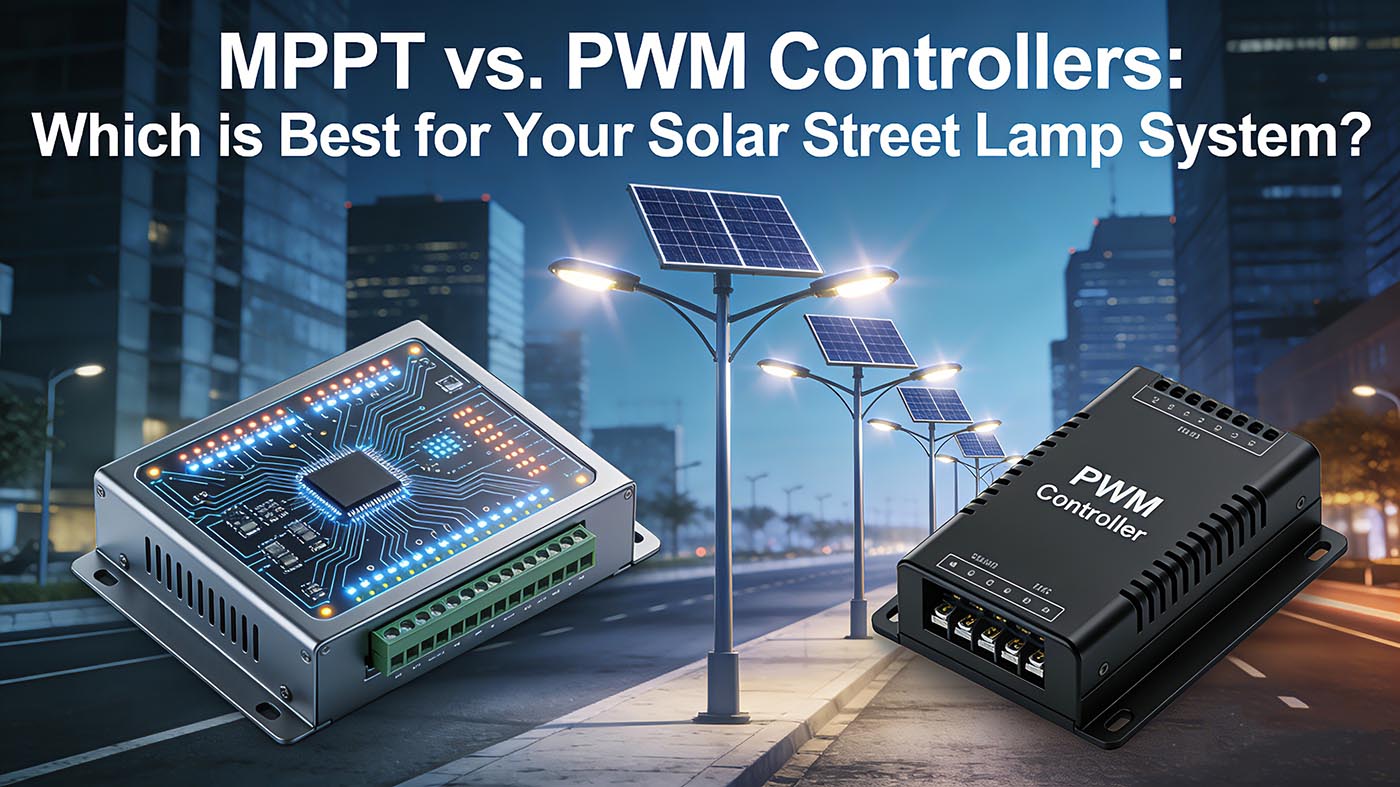
When it comes to solar street lamp systems, there is no one-size-fits-all “best” controller—the choice between MPPT (Maximum Power Point Tracking) and PWM (Pulse Width Modulation) hinges on your system’s power rating, budget, local sunlight conditions, and long-term energy efficiency goals.
MPPT controllers are the superior choice for most modern solar street lamp systems (especially high-power, all-in-one, or off-grid setups in variable light conditions), delivering far higher charging efficiency and better battery performance.
PWM controllers, by contrast, are a cost-effective, reliable option for small-power, simple solar street lamp setups with consistent sunlight and tight budgets.
At their core, both controllers serve the same critical purpose for solar street lamps: regulating the power flow from the solar panel to the battery (preventing overcharging, over-discharging, and short circuits) and ensuring safe, efficient energy storage for nighttime lighting.
The key difference lies in their charging technology, efficiency, and adaptability—factors that directly impact a solar street lamp’s runtime, battery lifespan, and overall system performance (a make-or-break detail for outdoor lighting that relies on consistent off-grid operation).
Below is a clear breakdown of how each controller works, their key pros and cons for solar street lamp systems, a side-by-side comparison, and a practical selection guide tailored specifically to solar street lamp applications.
Core Working Principle (Simplified for Solar Street Lamps)
Both controllers are designed for low-voltage DC solar systems (12V/24V, the standard for solar street lamps) and integrate seamlessly with their built-in lithium/lead-acid batteries—their operation is fully automated, so no manual intervention is needed for street lamp use.
PWM Controllers
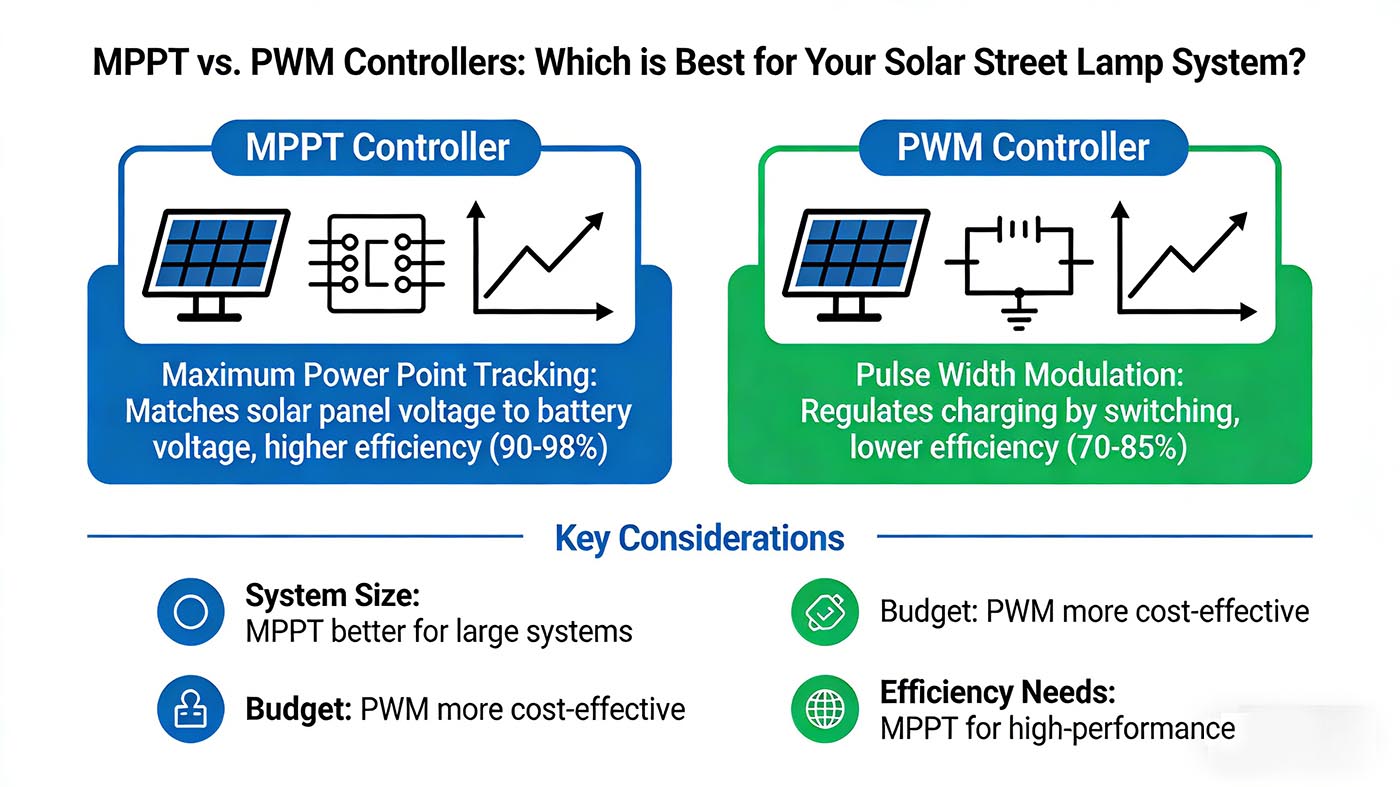
PWM (Pulse Width Modulation) is a basic, direct charging technology. It works by matching the output voltage of the solar panel to the nominal voltage of the battery (e.g., 12V panel to 12V battery). When the battery nears full charge, the controller uses rapid “on/off” pulses to reduce the charging current and maintain a steady voltage, preventing overcharging.
It is a passive charging system—it cannot adjust to changes in the solar panel’s output (caused by cloud cover, shade, or temperature) and simply draws power at the battery’s fixed voltage, leaving unused solar energy on the table.
MPPT Controllers
MPPT (Maximum Power Point Tracking) is an advanced, active charging technology—the “smart” choice for solar systems. It continuously scans and tracks the maximum power point (MPP) of the solar panel in real time (adjusting for sunlight intensity, temperature, shade, and battery charge level) and converts the panel’s variable voltage/current into the optimal power for the battery via a DC-DC converter.
For example, a 12V solar panel may output 18–22V in full sun; the MPPT controller steps this down to the battery’s charging voltage (13.6–14.4V for a 12V lithium battery) while retaining all the panel’s available power—it captures and uses nearly all the solar energy the panel produces, unlike PWM.
Key Pros & Cons for Solar Street Lamp Systems
The strengths and weaknesses of each controller are amplified in solar street lamp applications, where consistent runtime (even in rainy/weak light) and long battery life are non-negotiable, and installation/maintenance need to be minimal (for outdoor, often remote locations).
PWM Controllers: Pros & Cons
Core Advantages
- Ultra-low cost: Significantly cheaper than MPPT controllers (30–50% lower upfront cost)—ideal for budget-restricted small projects.
- Simple, compact design: Fewer electronic components, so it’s lightweight and easy to integrate into small solar street lamp housings; no complex calibration needed.
- Low maintenance & high reliability: A robust, no-frills design with fewer failure points—perfect for basic systems where simplicity is key.
- Low power consumption: The controller itself uses almost no energy, so there’s no “parasitic loss” for small systems.
Critical Disadvantages (for Solar Street Lamps)
- Low charging efficiency: Only 70–80% efficient (vs. 90–98% for MPPT)—wastes 20–30% of the solar panel’s output, which directly shortens the street lamp’s runtime in low light/rainy weather.
- Strict voltage matching: Requires the solar panel’s voltage to match the battery’s nominal voltage (12V panel → 12V battery); no flexibility for mixed-voltage setups.
- Poor adaptability to variable light: Cannot adjust for shade, cloud cover, or temperature changes—charging performance drops sharply in non-ideal sunlight (a major issue for solar street lamps in high-latitude, cloudy, or tree-shaded areas).
- Basic battery protection: Only offers standard overcharge/over-discharge protection (no advanced thermal or current regulation)—can shorten battery lifespan in extreme outdoor temperatures (hot/cold).
MPPT Controllers: Pros & Cons
Core Advantages (Game-Changers for Solar Street Lamps)
- Exceptional charging efficiency: 90–98% charging efficiency captures nearly all solar energy produced—adds 2–5 hours of runtime for solar street lamps in weak light, and ensures 3–7+ rainy days of operation (a key selling point for quality solar street lamps).
- Wide voltage adaptability: Works with solar panels of higher voltage than the battery (e.g., 24V panel → 12V battery, 48V panel → 24V battery)—flexible for high-power solar street lamp systems and allows for larger solar panels to boost energy collection.
- Superior battery protection: Integrates advanced thermal regulation, current limiting, and multi-stage charging (bulk → absorption → float)—slows battery aging, extends its cycle life by 30–50% (critical for solar street lamps, where battery replacement is costly and time-consuming).
- Excellent environmental adaptability: Real-time MPP tracking ensures consistent charging even in partial shade, cloud cover, extreme temperatures, or high-latitude areas—eliminates the “light failure” issue of PWM-equipped street lamps in bad weather.
- Future-proof: Works with all battery types (lithium iron phosphate, lead-acid, Li-ion—the mainstream for solar street lamps) and high-power LED light sources (30W–200W, the standard for modern street lamps).
Minor Disadvantages
- Higher upfront cost: More expensive than PWM controllers (the only significant downside)—but the cost is quickly offset by energy savings, longer battery life, and reduced maintenance over 2–3 years.
- Slightly more complex design: Integrates a DC-DC converter, but for all-in-one solar street lamps, this is irrelevant—the MPPT controller is pre-integrated into the housing with no extra installation or calibration needed.
- Minimal parasitic loss: The controller uses a small amount of energy for MPP tracking (≤1% of system power)—negligible for high-power solar street lamp systems.
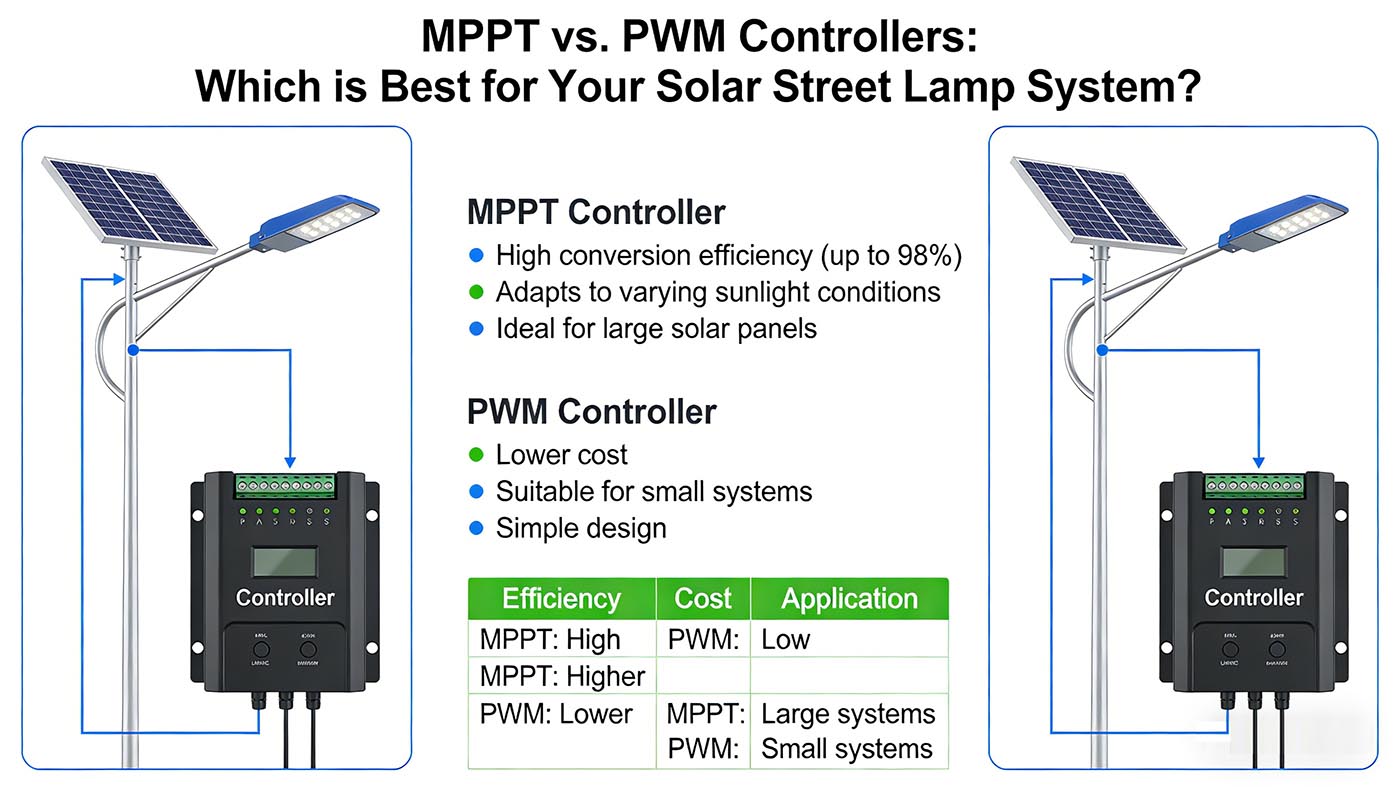
Side-by-Side Comparison (Tailored to Solar Street Lamp Systems)
| Feature |
PWM Controllers |
MPPT Controllers |
| Charging Efficiency |
70–80% (wastes solar energy) |
90–98% (captures nearly all solar energy) |
| Upfront Cost |
Low (budget-friendly) |
High (premium, but cost-effective long-term) |
| Voltage Compatibility |
Strict 1:1 matching (12V panel →12V battery) |
Flexible (higher panel voltage → battery) |
| Power Adaptability |
Ideal for ≤30W small-power street lamps |
Best for ≥30W high-power street lamps (30W–200W) |
| Battery Life Impact |
Basic protection (shorter battery life) |
Advanced protection (30–50% longer battery life) |
| Light Condition Adaptability |
Poor (performance drops in shade/rain) |
Excellent (consistent charging in all light) |
| Suitable Battery Types |
Lead-acid (primary), small lithium packs |
All (LiFePO4, Li-ion, lead-acid—mainstream for street lamps) |
| Installation & Maintenance |
Plug-and-play, zero maintenance |
Pre-integrated (all-in-one lamps), zero maintenance |
| Runtime for Street Lamps |
Shorter (1–3 rainy days) |
Longer (3–7+ rainy days) |
Practical Selection Guide: Which to Choose for Your Solar Street Lamp System?
Use this application-specific guide to make the right choice—it’s based on the most common solar street lamp use cases (residential roads, rural villages, main roads, parks, industrial parks) and key project factors.
Choose PWM Controllers If:
- Your system is small-power (≤30W) (e.g., 10W/20W solar street lamps for narrow rural paths, garden walkways, or small courtyards).
- Your local sunlight is consistently strong (low-latitude areas, no shade/cloud cover, minimal rainy days).
- Your project has a tight upfront budget and you prioritize cost over long-term efficiency/runtime.
- You’re using basic lead-acid batteries (not high-performance lithium batteries) for a simple, temporary lighting setup.
Choose MPPT Controllers If:
- Your system is high-power (≥30W) (e.g., 30W–200W all-in-one solar street lamps for main roads, residential communities, parks, or industrial parks)—the most common scenario for modern solar street lamps.
- Your local sunlight is variable (high-latitude areas, frequent cloud cover/rain, partial shade from trees/buildings).
- You prioritize long-term value (lower total cost of ownership: energy savings, longer battery life, less maintenance).
- You’re using lithium iron phosphate (LiFePO4) batteries (the industry standard for solar street lamps)—MPPT’s advanced protection maximizes their 2000+ cycle life.
- You need reliable rainy-day runtime (3–7+ days)—a key requirement for commercial/ municipal solar street lamp projects.
- You want a future-proof system (compatible with larger solar panels or higher-power LEDs for upgrades).
MPPT controllers are the best choice for 90% of modern solar street lamp installations—including all-in-one, high-power, and municipal/ commercial systems. While they have a higher upfront cost, their superior charging efficiency, longer battery life, and reliable performance in all light conditions make them the most cost-effective option over the system’s 5–15 year lifespan (the typical service life of a solar street lamp).
For solar street lamp manufacturers and installers, MPPT is now the de facto industry standard—it’s a key selling point that differentiates high-quality, reliable solar street lamps from cheap, low-performance models.
PWM controllers are only a viable choice for small-power, budget, or temporary solar street lamp setups in areas with perfect, consistent sunlight. They should be avoided for any high-power or off-grid solar street lamp system where reliable nighttime lighting and rainy-day runtime are non-negotiable.
A Critical Note for All-in-One Solar Street Lamps
Nearly all premium all-in-one solar street lamps on the market now come with a built-in MPPT controller (no extra cost for integration).
This eliminates the need to choose between PWM and MPPT for pre-assembled all-in-one systems—simply select a reputable brand with a confirmed MPPT controller for the best performance.
Main Features:
1. Exclusive controller for Lithium Battery, which suit for ternary Lithium, Lithium iron battery, Lithium cobalt oxides battery, etc.
2. Unique Lithium battery which is automatically actuated.
3. Flexible charging mode, equalizing charge or PWM charge auto switch.
4. Lithium battery low temperature charging protection, when the ambient temperature is lower than 0℃, the controller will auto stop low temperature charging so as to protect the battery.
5. Digital high precision constant-current control, the maximum efficiency can reach 96%.
6. The working current can be adjusted from 0.15A to 3.3A, the regulating precision is 30mA.
7. High dynamic performances of load insure current output stability even though the battery voltage
and load sudden change.
8. 3 level time frame dimming function design, work time can be set range from 0 hour to 15 hours, power can be set range from 0% to 100%.
9. Intelligent power mode, the load power can be adjusted automatically according to the battery power, can extend the maximum working time of the battery. 10. Record the system status, can record at a max 7days and monitor the whole system.
11. The true constant current but not limited current, which can insure the current output stability thus decrease LED light failure and increase the LED service life.
12. Metal case, IP68 waterproof degree, can be used in all kinds of bad conditions.
13. Overheat protection function, when the controller reaches a certain temperature, it will decrease or close the load.
14. Varies system protection. Including the battery reverse connection, LED short circuit, open circuit protection and so on.






 IPv6 network supported.