Solar street light time control methods are core to balancing illumination demand, energy saving and battery lifespan, and are often integrated with light sensing, induction and smart communication for practical use.
Below are the mainstream, market-proven time control methods (sorted by popularity and application scope), with their working principles, advantages, disadvantages and applicable scenarios—tailored for solar street light product technical specifications, marketing copy and project solutions.
All methods are based on the solar charge-discharge controller (the "brain" of the light), and most support segmented power adjustment (e.g., full power for a set time, then half power) as an energy-saving auxiliary function, which is the standard configuration for modern solar street lights.
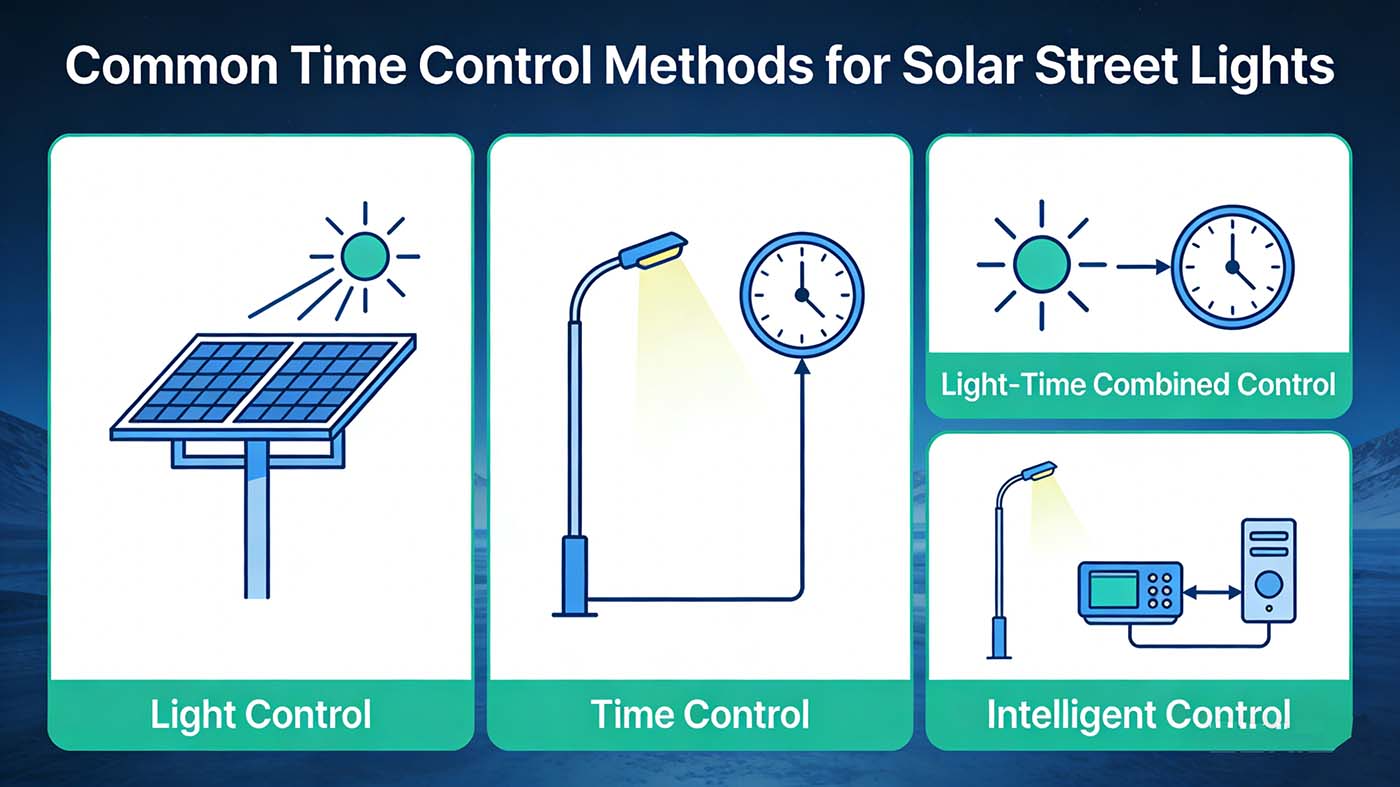
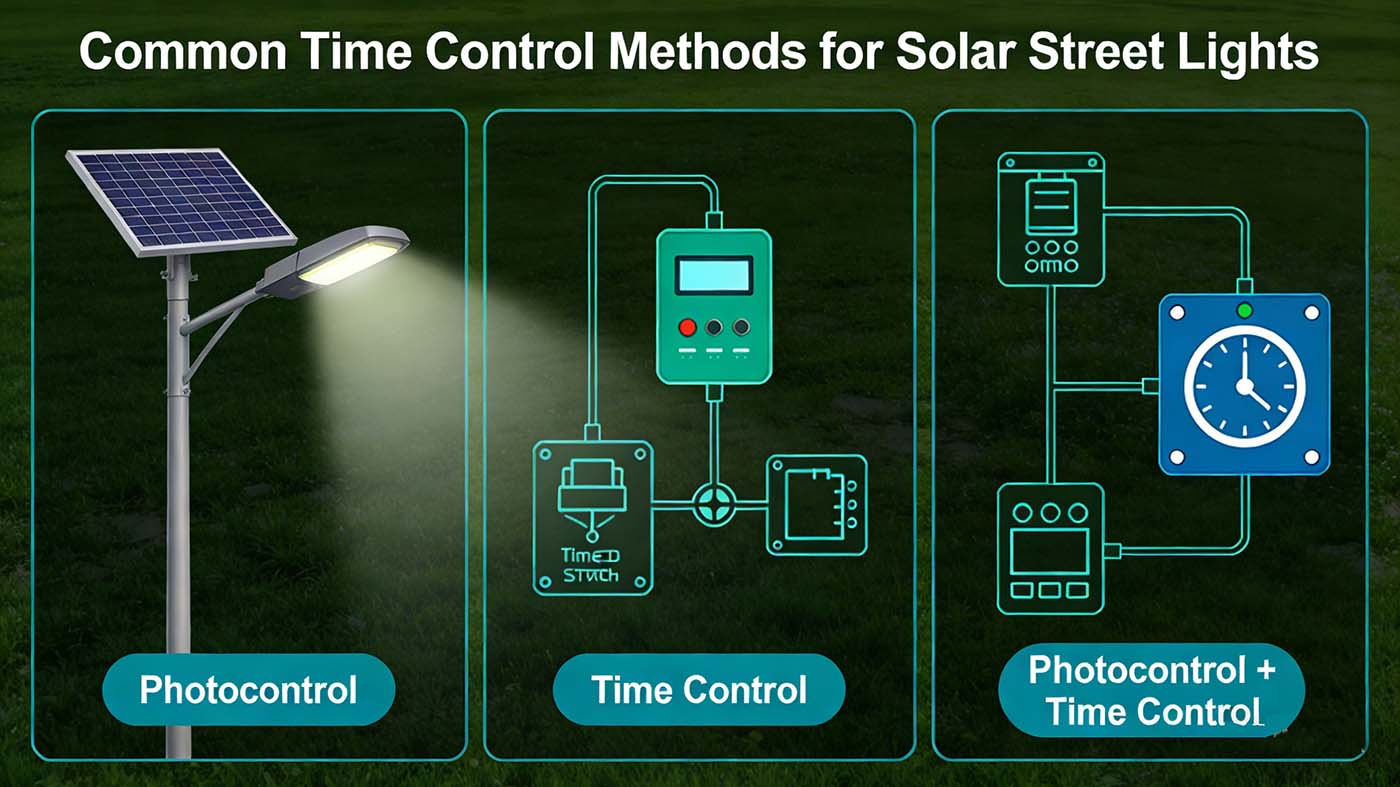
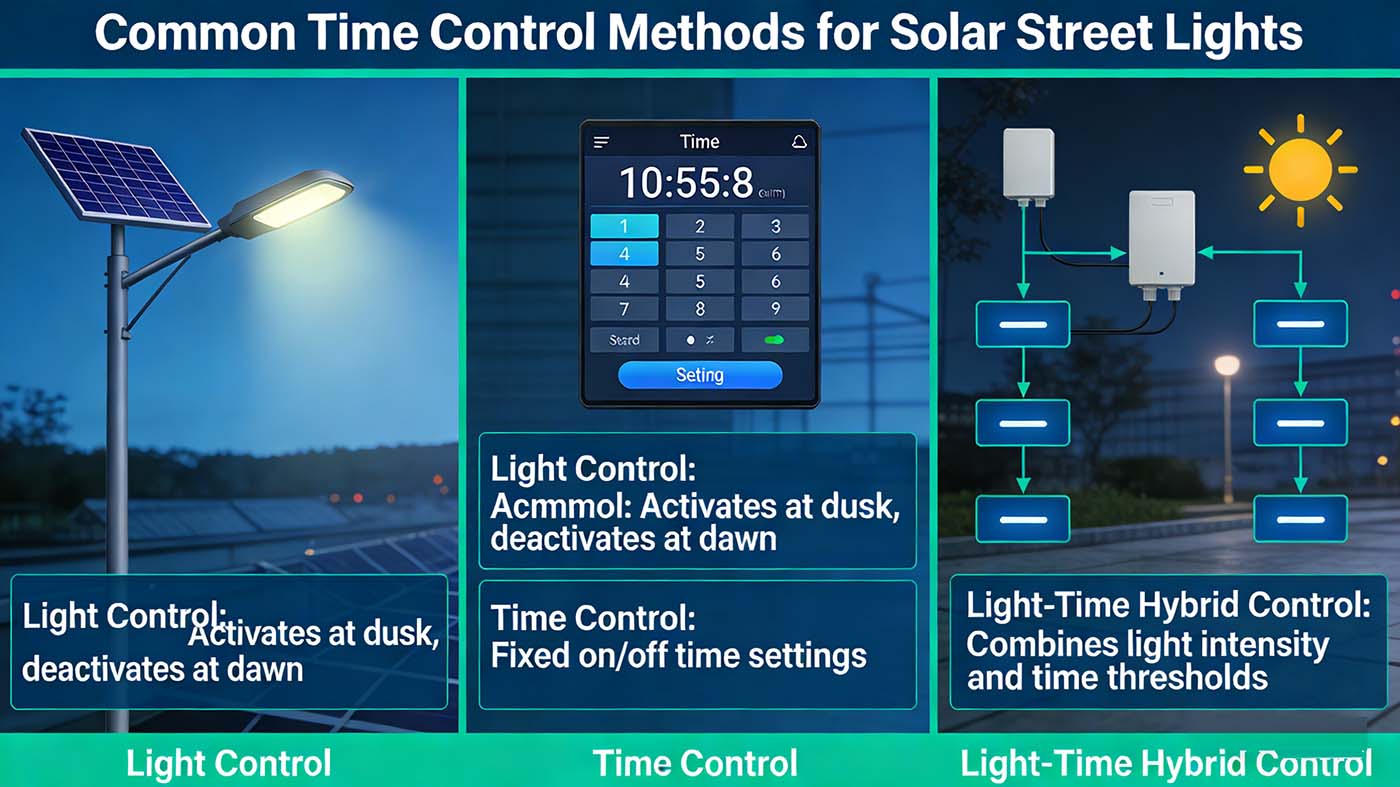
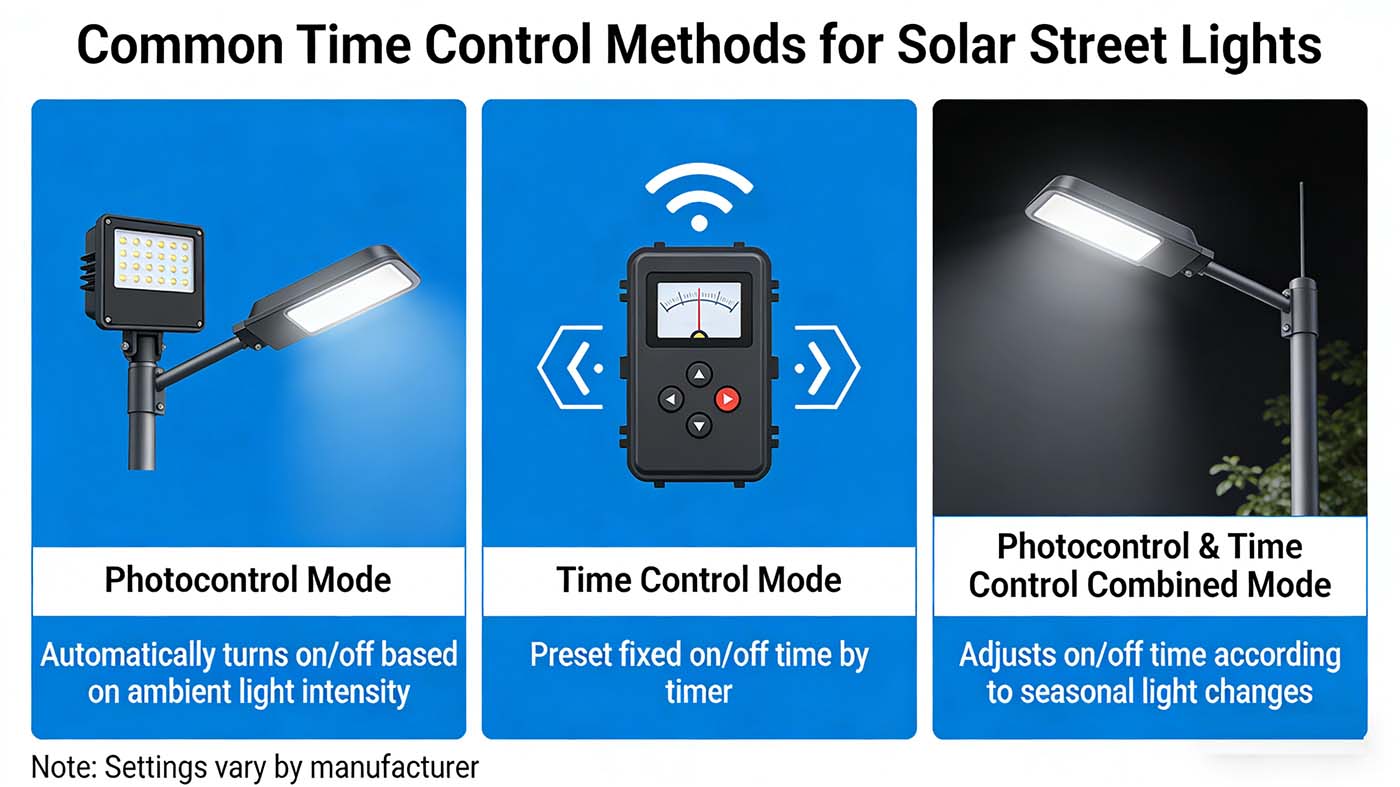
1. Light + Time Combined Control (Most Popular & Universal)
Working Principle
The most widely used method for solar street lights (accounting for over 80% of general scenarios). It triggers lighting via light sensing and controls the working duration/power via time setting:
- Light control trigger: Automatically turns on when the ambient illuminance drops to a preset threshold (5–15 lux, adjustable) and turns off when the illuminance rises above the threshold at dawn;
- Time control regulation: After the light is turned on by light sensing, it operates according to the preset time program (e.g., full power for 4 hours → half power for 4 hours, or fixed time off like "turn off at 2 AM").
Advantages
Low cost, easy operation, no manual trigger, adapts to seasonal changes of day/night length, and balances basic illumination and energy saving.
Disadvantages
Susceptible to interference from ambient artificial light (e.g., billboard lights, building neon lights); the illuminance threshold needs on-site debugging.
Applicable Scenarios
Urban secondary roads, residential community roads, rural highways, park paths (all general solar street light application scenarios—the first choice for standard products).
2. Longitude & Latitude Smart Timing Control (High Precision for Municipal Projects)
Working Principle
An upgraded intelligent time control method based on geographic location: the controller has a built-in longitude and latitude algorithm; after inputting the installation location’s longitude and latitude, it automatically calculates the local sunrise/sunset time, and dynamically updates the on/off time with seasonal changes (no manual adjustment for spring/summer/autumn/winter). It can be superimposed with segmented power time control (full/half power) and light control for double insurance.
Advantages
Ultra-high timing precision, no seasonal debugging required, anti-ambient light interference, and one-time setting for permanent use.
Disadvantages
Slightly higher controller cost than basic light-time control; requires accurate input of the installation site’s longitude and latitude.
Applicable Scenarios
Municipal main roads, high-specification industrial parks, cross-latitude engineering projects, large-scale scenic area roads (key government projects with high requirements for automation and precision).
3. Sensor + Time Control (Energy-Saving Type for Low Traffic Flow)
A high-efficiency energy-saving solution combining human/vehicle induction with time control, often used with light control (the most cost-effective energy-saving method for solar street lights). The two mainstream induction technologies are microwave (radar) induction (recommended, anti-interference) and human infrared induction (for pedestrian-only areas).
Working Principle
Light control triggers the light to turn on in low-power constant brightness mode (20%–30% of rated power); when the sensor detects a human/vehicle passing by, it automatically boosts to full power for illumination; after the induction ends, it delays for a preset time (30s–5min, adjustable) and restores low power. It can be superimposed with time control: e.g., turn off the induction function after 00:00 and keep low power, or turn off the light directly at a fixed time.
Advantages
Maximizes energy saving (energy saving rate up to 60%–80%), prolongs battery and LED lamp life, and balances basic security illumination (low power) and high-brightness demand (induction full power).
Disadvantages
Higher cost than basic light-time control; the induction distance/angle needs on-site debugging.
Applicable Scenarios
Sidewalks, residential footpaths, country lanes, park trails, industrial park secondary roads (areas with uneven pedestrian/vehicle flow and high energy-saving requirements).
4. Manual Fixed Timing Control (Basic & Backup Type)
The most traditional time control method, the foundation of all other control modes (now mostly used as a backup function for other intelligent control methods).
Working Principle
Set the fixed on/off time and power segment directly through the physical buttons or digital display of the solar controller (e.g., turn on at 18:00, full power for 3 hours, half power for 3 hours, turn off at 00:00). No automatic adjustment for external factors (light, season, human/vehicle).
Advantages
Simple operation, lowest controller cost, suitable for areas with completely fixed lighting schedules.
Disadvantages
Requires manual re-adjustment for seasonal changes of day/night length; high maintenance cost for large-scale projects; cannot adapt to actual illumination demand.
Applicable Scenarios
Remote rural villages with fixed living schedules, small temporary construction sites, simple courtyard solar street lights (low-budget, small-scale simple scenarios), or as a backup for intelligent control failure.
5. Smart Remote Time Control (IoT Type for Smart City)
The high-end time control method for smart city projects, integrating IoT communication technology with all the above time control/induction/light control functions.
Working Principle
The solar street light controller is equipped with GPRS/4G/LoRa/WiFi communication modules and connects to a cloud management platform. The on/off time, power segmentation, induction parameters, and light control threshold can be set and adjusted in real time via computer/mobile phone APP/wechat mini program; it supports batch management of hundreds/thousands of street lights, and real-time monitoring of battery power, lamp working status and fault alarm.
Advantages
Remote batch operation, no on-site debugging required; flexible and real-time adjustment of lighting schedules according to actual demand; intelligent fault monitoring reduces maintenance cost; supports personalized timing strategies (e.g., different time control for weekends/weekdays).
Disadvantages
Highest overall cost (controller + communication module + cloud platform); dependent on network signal (unavailable in remote areas without 4G/LoRa coverage).
Applicable Scenarios
Smart city municipal roads, large industrial parks, airport peripheral roads, scenic areas with unified management, commercial block roads (large-scale, high-specification intelligent lighting projects).
🌟 Key Supplementary: Segmented Power Time Control (Universal Auxiliary Function)
All the above time control methods can be superimposed with segmented power timing—the core energy-saving design of solar street lights (a must-mention technical point in product marketing). It means the light automatically adjusts the illumination power in different time periods after turning on (e.g., 18:00–22:00 full power [100W] for peak traffic, 22:00–06:00 half power [50W] for low traffic), which effectively saves solar panel and battery energy without affecting basic illumination.
📊 Market Application Summary
| Control Method |
Cost Level |
Applicable Scenario |
Market Popularity |
| Light + Time Combined |
Medium |
General roads (most scenarios) |
★★★★★ |
| Longitude & Latitude Timing |
Medium-High |
Municipal high-spec projects |
★★★★☆ |
| Sensor + Time Control |
Medium |
Low traffic flow energy-saving areas |
★★★★☆ |
| Manual Fixed Timing |
Low |
Simple small-scale/backup |
★★☆☆☆ |
| Smart Remote Time Control |
High |
Smart city/large-scale IoT projects |
★★★☆☆ |
The mainstream configuration of commercial solar street light products in the market is Light + Time Combined Control (main) + Manual Timing (backup), and the mid-to-high end models are upgraded to Longitude & Latitude Timing + Microwave Induction + Segmented Power for higher competitiveness.






 IPv6 network supported.