2025 Solar Street Light News & World Development: A Comprehensive Overview
2025 has been a transformative year for the global solar street lighting industry, marked by accelerated market growth, technological breakthroughs, and large-scale deployments across developing and developed nations alike. The sector has evolved from simple off-grid lighting solutions to becoming a cornerstone of smart cities and sustainable infrastructure worldwide.
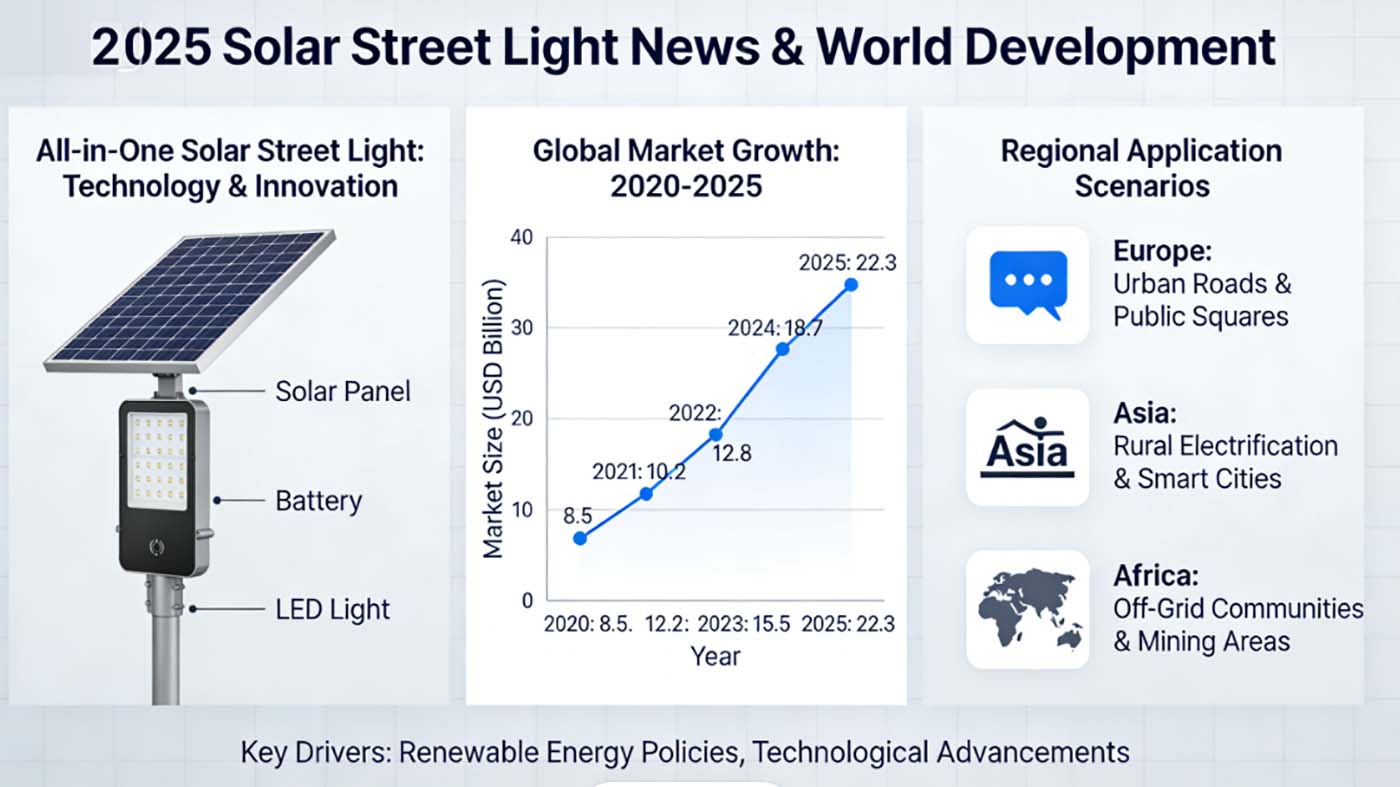
📈 Market Size & Growth Trajectory
| Metric |
2025 Data |
2029 Projection |
CAGR |
| Global Market Value |
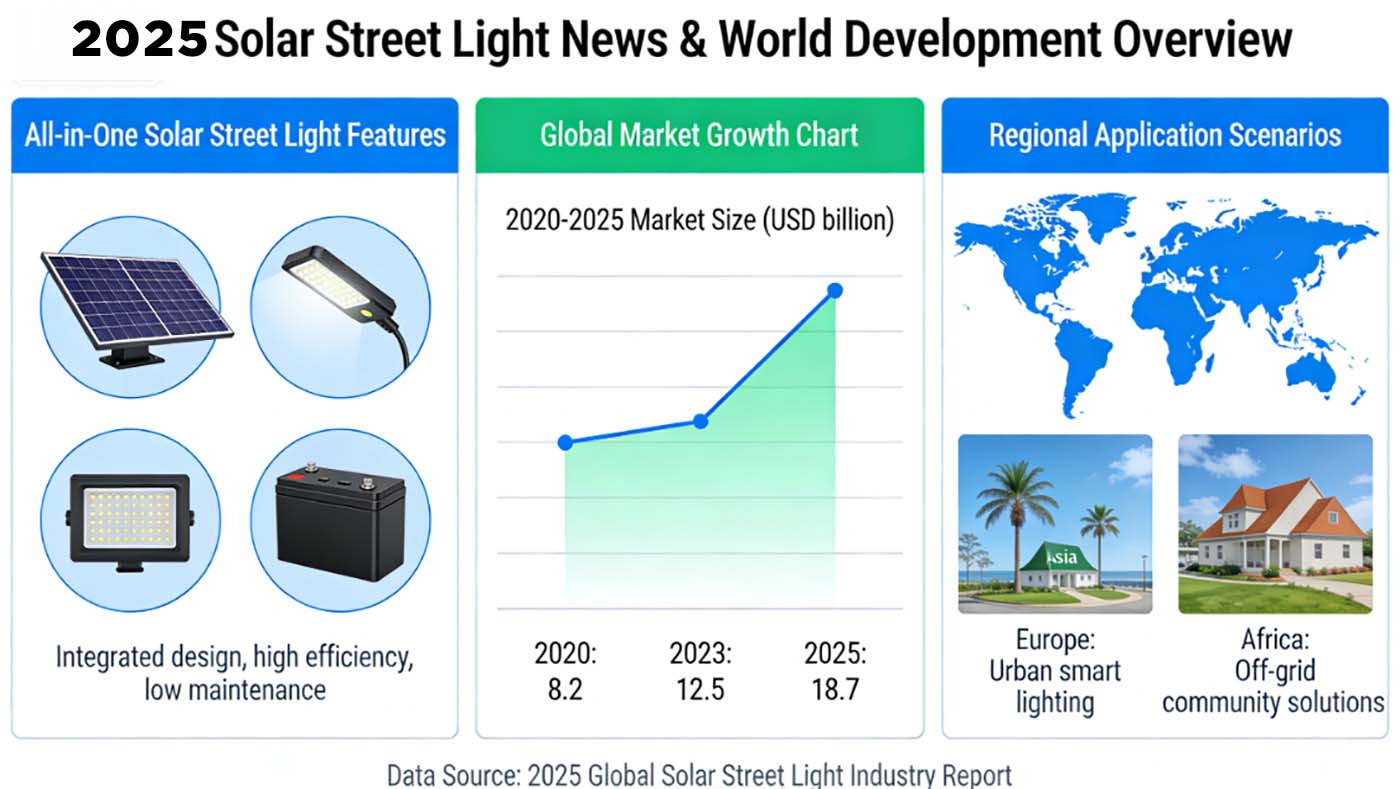
USD 12-15.85 billion |
USD 22.02-44.81 billion |
16.0-17.0% |
| Asia Pacific Dominance |
52% market share (largest regional market) |
Maintained leadership |
- |
| China Market Size |
CNY 180 billion+ |
- |
- |
| Global Solar Penetration |
40-50% in public lighting |
65%+ |
- |
The market expansion is primarily driven by:
- Rising energy costs and grid infrastructure limitations in developing regions
- Stringent carbon reduction policies (e.g., China's "Dual Carbon" goals, EU Green Deal)
- Smart city initiatives requiring integrated infrastructure solutions
- Technological advancements reducing costs and improving performance
🔧 Technological Innovations Shaping 2025
1. All-in-One Systems & Smart Integration
The most significant trend in 2025 has been the mainstream adoption of all-in-one solar street lights with advanced smart features:
- IoT connectivity: Remote monitoring, fault detection, and centralized management via cloud platforms
- AI optimization: Adaptive brightness based on traffic patterns, weather conditions, and energy consumption analysis
- Motion detection: 30-50% energy savings by dimming when no activity is detected
- Multi-functional smart poles: Integration with 5G small cells, EV charging stations, environmental sensors, and security cameras
2. Battery Technology Revolution
- LiFePO₄ (LFP) batteries have become the industry standard, replacing lead-acid and traditional lithium-ion batteries
- 3,000+ charge cycles (vs. 500 for lead-acid)
- Enhanced safety (no thermal runaway risk)
- Wider operating temperature range (-20°C to 60°C)
- Solid-state batteries entering pilot phases, offering 2x energy density and faster charging
3. Photovoltaic & LED Efficiency Gains
- Monocrystalline solar panels with 23-25% conversion efficiency as standard
- High-lumen LEDs (180-200 lumens per watt) reducing energy consumption by 40% compared to conventional street lights
- Anti-reflective coatings and self-cleaning surfaces improving performance in dusty environments
4. Hybrid & Grid-Interactive Solutions
- Grid-tied solar street lights with bidirectional power flow, enabling energy sharing with the main grid
- Wind-solar hybrid systems gaining traction in coastal and high-wind regions
- Energy storage integration allowing lights to function as mini-grid stabilizers during outages
🌍 Regional Development Highlights
Asia Pacific: The Growth Engine
- China: New Renewable Energy Law mandates 30% minimum solar share in public lighting projects, driving 25% growth in government procurement. Rural areas account for 58% of installations.
- India: National Solar Mission Phase 4 includes 5 million solar street light targets by 2027, with 1.2 million installed in 2025 alone.
- Southeast Asia: Vietnam, Thailand, and Indonesia see 22% annual growth due to rising electricity costs and infrastructure development.
Africa & Middle East: Infrastructure Transformation
- Yemen: UNOPS installed 450 solar street lights in Dhamar city, improving safety and reducing CO₂ emissions by 200+ tonnesUNOPS.
- Senegal: 10,000+ solar street lights deployed across rural communities, eliminating reliance on expensive diesel generators.
- Saudi Arabia: 500+ high-powered (140W) all-in-one solar street lights installed in Riyadh suburbs.
Americas: Sustainable Urban Planning
- United States: Kentucky Transportation Cabinet (KYTC) rolling out solar lighting across multiple districts, with internal crews trained to install units in under 45 minutes per light.
- Caribbean: China's South-South cooperation provided 1,500 solar street lights to Antigua and Barbuda, supporting their climate resilience goals.
- Costa Rica: SOLTECH's HYPER Series replaced conventional grid streetlights along critical roadways, achieving 100% energy independence.
Europe: Smart City Pioneers
- Germany: Berlin and Munich integrating solar street lights with smart traffic management systems, reducing congestion and energy use simultaneously.
- France: Paris testing solar-powered "smart poles" with air quality sensors and EV charging capabilities in preparation for the 2024 Olympics legacy projects.
🚧 Major Projects of 2025
-
China-Antigua and Barbuda Climate Cooperation Project (December 2025)
- 2,000 solar street lights + 200 household energy storage systems
- Reduced carbon emissions by 3,000+ tonnes annually
- Improved public safety and extended business hours in rural communities
-
Congo Village Electrification Initiative (November 2025)
- 366 all-in-one solar street lights installed across 6 villages
- First-time access to reliable nighttime lighting for 8,000 residents
-
Yemen Urban Services Emergency Project (September 2025)
- 450 solar street lights along Dhamar city's main and western ring roads
- Implemented by UNOPS to address critical infrastructure gapsUNOPS
-
Los Angeles Smart Solar Street Light Program (July 2025)
- 5,000 IoT-enabled solar street lights replacing aging grid systems
- Integration with city's existing smart traffic and public safety networks
🔭 Future Outlook: 2026-2030
- Market Consolidation: Top 5 manufacturers (including China's LEADRAY, Phono Solar, and Eolgreen) expected to control 40% of global market share by 2027.
- Cost Parity: Solar street lights projected to reach total cost of ownership parity with grid-connected alternatives by 2026 in most regions.
- AI-Driven Optimization: Machine learning algorithms will enable predictive maintenance and energy forecasting, reducing operational costs by 30%.
- Decentralized Energy Ecosystems: Solar street lights will evolve into "micro-energy hubs," powering small community loads and electric vehicles.
- Standardization: Global technical standards for smart solar street lights expected by 2028, improving interoperability and reducing deployment complexity.
📌 Key Takeaways
2025 has proven to be a pivotal year for solar street lighting, with the industry transitioning from niche applications to mainstream infrastructure solutions.
The convergence of affordable technology, strong policy support, and growing demand for sustainability has created an unstoppable momentum that will continue to transform urban and rural landscapes worldwide.
As we move into 2026, the focus will shift from simply installing solar street lights to fully integrating them into the fabric of smart, resilient cities, where they will serve as both lighting sources and critical data collection nodes in the Internet of Things.






 IPv6 network supported.