Intelligent Monitoring Solution Adaptability: Integrated vs. Split Solar Street Lights
The suitability of intelligent monitoring solutions (e.g., remote dimming, fault warning) for integrated and split solar street lights is mainly determined by their structural characteristics, installation scenarios, and maintenance requirements. Below is a targeted analysis of the matching schemes for both types:
1. Suitable Intelligent Monitoring Solutions for Integrated Solar Street Lights
Integrated solar street lights feature a highly integrated design, with solar panels, LEDs, lithium batteries, and controllers all housed in a single enclosure. This structure imposes requirements of simplicity, miniaturization, and low power consumption on monitoring systems.
1.1 Remote Dimming Solution
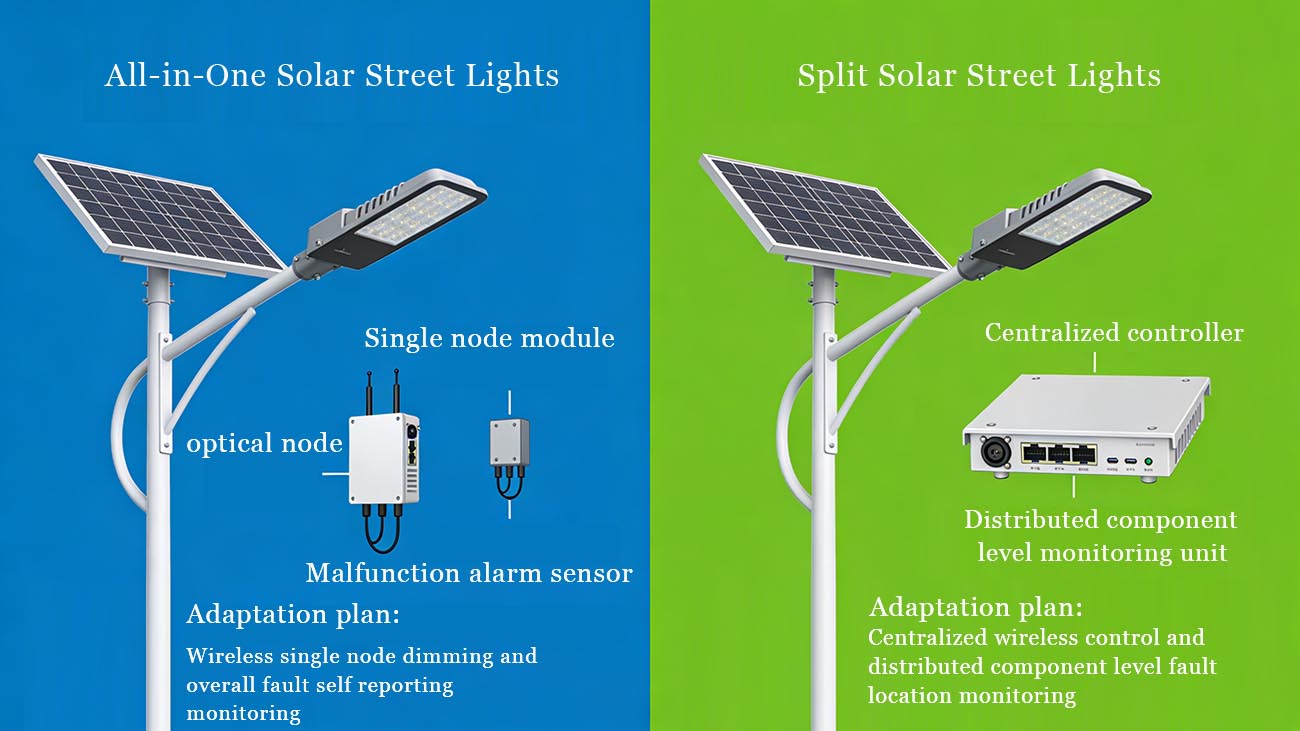
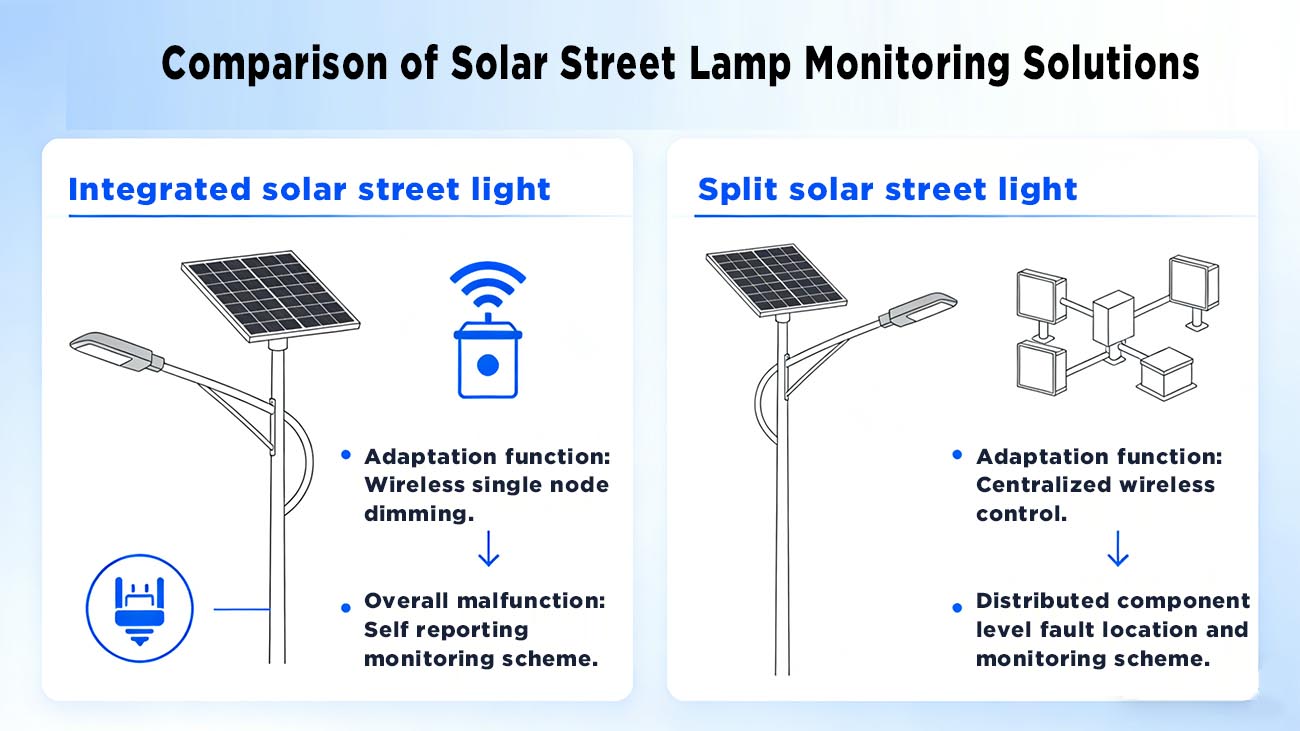
- Recommended Scheme: Wireless single-node dimming system based on LoRa/NB-IoT communication
- Adaptability Analysis:
- Integrated street lights have no external wiring, so wireless communication avoids the trouble of additional cable laying.
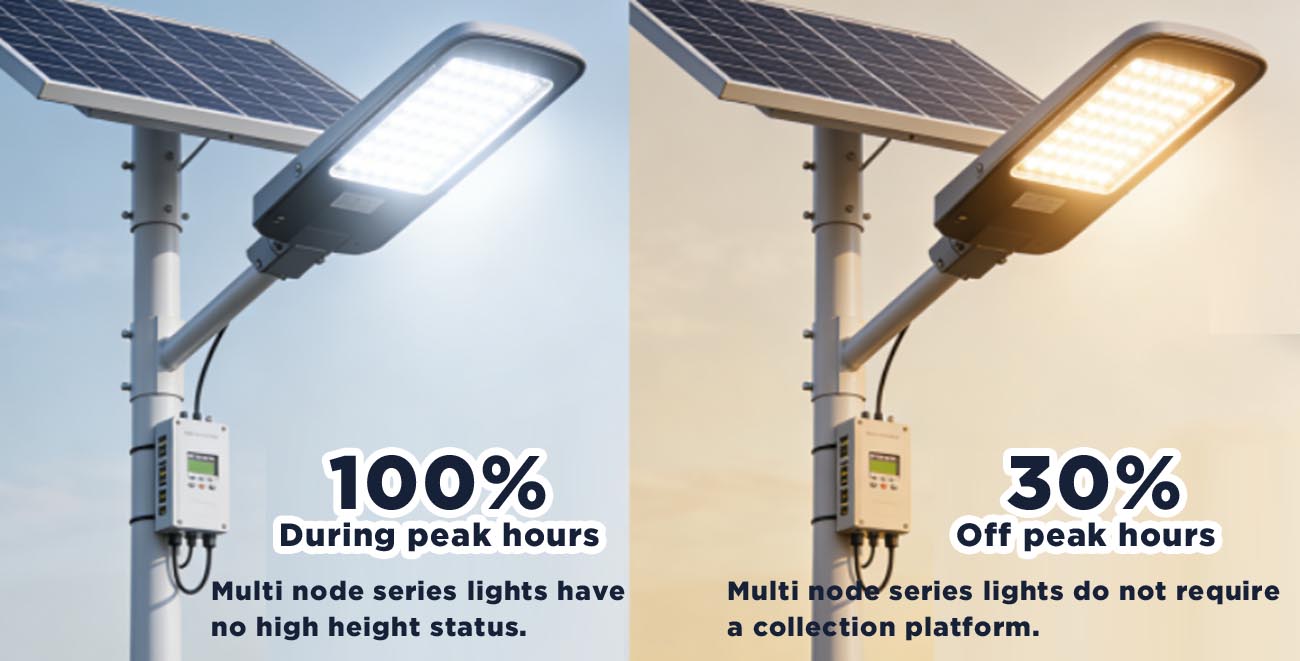
- The load power of a single integrated street light is relatively limited (usually within 300W). The single-node dimming mode can independently adjust the brightness of each lamp (e.g., switching between 100% brightness at peak hours and 30% energy-saving brightness at off-peak hours) without relying on a complex centralized control platform.
- The built-in controller of integrated street lights can be pre-embedded with dimming control modules during production, realizing plug-and-play without post-installation modification.
1.2 Fault Warning Solution
- Recommended Scheme: Integrated sensor + cloud platform fault self-reporting system
- Adaptability Analysis:
- Embedded voltage and current sensors inside the lamp body can monitor the operating status of the battery, LED driver, and solar charging module in real time. When anomalies such as battery over-discharge, LED burnout, or charging failure occur, the system automatically sends alarm information to the cloud platform via wireless signals.
- Given the integrated structure, it is impossible to monitor components separately. The solution focuses on overall fault diagnosis (e.g., identifying abnormal charging efficiency of the whole machine, lamp body short circuit) rather than single-component fault location, which matches the maintenance logic of integrated street lights (usually replacing the whole machine directly when a fault occurs).
- Suitable for scenarios with a large number of decentralized installations (e.g., rural roads, courtyards), where managers can receive alarm messages remotely without on-site inspections.
Split solar street lights separate solar panels, batteries, lamp heads, and controllers into independent modules, with distributed installation. Their monitoring systems require modularity, strong expandability, and multi-component independent monitoring capabilities.
2.1 Remote Dimming Solution
- Recommended Scheme: Centralized wireless control system based on GPRS/4G communication
- Adaptability Analysis:
- Split street lights are often used in high-power scenarios (e.g., urban main roads, squares, with single-lamp power above 300W). Centralized control can realize unified dimming of regional street lights (e.g., adjusting the brightness of all street lights in a certain road section synchronously according to traffic flow).
- The independent controller of split street lights can be connected to multiple load modules, supporting flexible dimming strategies (e.g., stepwise dimming, human radar induction linkage dimming). It can also link with traffic monitoring data to adjust brightness in real time (increasing brightness during peak traffic hours and reducing brightness during low-traffic periods).
- For large-scale projects, the centralized control platform can realize group management of street lights, which is more efficient than single-node control of integrated street lights.
2.2 Fault Warning Solution
- Recommended Scheme: Distributed multi-node monitoring system with component-level fault positioning
- Adaptability Analysis:
- Split street lights allow independent deployment of monitoring sensors for each module: solar panel power generation sensors, battery temperature and voltage sensors, lamp head current sensors, etc. This enables component-level fault positioning (e.g., distinguishing whether the charging failure is caused by a damaged solar panel or a faulty controller; identifying whether the lamp does not light up due to LED driver damage or battery depletion).
- The monitoring system can be connected to the cloud platform through a centralized gateway, realizing unified data collection and alarm management. Maintenance personnel can directly carry targeted spare parts for on-site repairs according to the alarm information, avoiding the high cost of overall replacement (a key advantage of split street lights in later maintenance).
- Suitable for large-scale municipal projects, where precise fault positioning can significantly reduce maintenance costs and shorten troubleshooting time.
3. Comparative Summary of Monitoring Solutions for Two Types of Street Lights
| Monitoring Function |
Integrated Solar Street Lights |
Split Solar Street Lights |
| Remote Dimming |
Wireless single-node dimming; simple operation; suitable for decentralized small-power scenarios |
Centralized group dimming; flexible strategy; suitable for large-scale high-power scenarios |
| Fault Warning |
Integrated overall fault self-reporting; fast alarm; maintenance relies on overall replacement |
Distributed component-level fault positioning; precise troubleshooting; supports targeted maintenance |
| Communication Mode |
Priority to LoRa/NB-IoT (low power consumption, long transmission distance) |
Priority to GPRS/4G (large data volume, strong real-time performance) |
| Cost Control |
Low initial deployment cost; no additional wiring required |
Slightly higher initial cost; but lower long-term maintenance cost for lar |






 IPv6 network supported.